

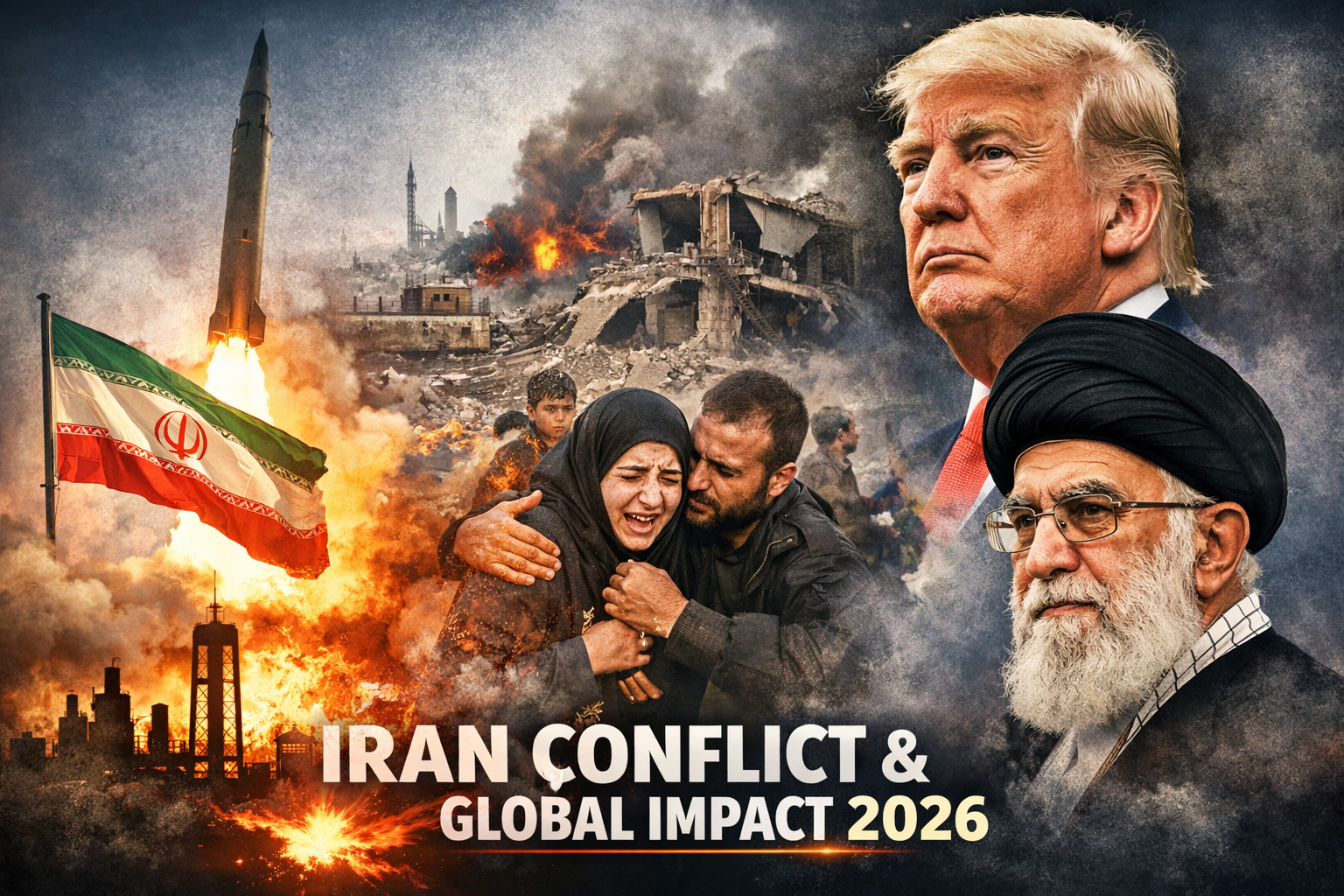
The world has once again landed on the brink of a major geopolitical crisis as the United States and Israel launched military strikes deep inside Iran in February 2026. Targeting strategic military and nuclear-linked sites, these strikes reported as one of the most serious escalations in years have triggered sharp retaliation from Tehran, regional instability, and global ripple effects.
How the Conflict Began
The roots of the 2026 conflict trace back to years of tension over Iran’s nuclear program, regional influence, and U.S.–Iran hostility. For decades, Iran’s ambitions to expand its military reach and support allied armed groups in the Middle East have collided with U.S. and allied security concerns. In early 2026, this tension culminated in a joint U.S. Israeli operation that reportedly killed Iran’s Supreme Leader and top commanders, triggering full-scale retaliation via missiles and drones across the Gulf region.
Many analysts argue that this escalation was not accidental but the result of a broader pattern of pressure tactics sanctions, diplomatic isolation, and military threats that have plagued U.S. Iran relations for years. These patterns are rooted in strategic competition over influence in the Middle East, fear of nuclear proliferation, and a desire by powers like the U.S. to counterbalance Iran’s regional network of proxies and allies.
Why the Conflict Matters Globally
1. Economic Shockwaves
One of the most immediate effects of the Iran conflict has been dramatic volatility in global energy markets. The Strait of Hormuz, a narrow but vital sea passage through which around one-fifth of the world’s oil flows, has been effectively disrupted due to hostilities. This has spiked oil prices and sent shockwaves through supply chains worldwide.
This isn’t only an oil story global prices for fuel, natural gas, and even transportation costs have surged, pushing up costs for consumers and businesses alike. Airlines, shipping companies, and industries that rely on petroleum products are scrambling to adapt, reroute, and manage higher war-risk premiums.
In Europe, natural gas prices have soared due to reduced shipments, intensifying concerns about energy security. In Asia, where nations like India and China rely heavily on crude oil transported through the Strait of Hormuz, energy insecurity is becoming a national economic issue.
2. Geopolitical Realignment
The conflict has the potential to redraw alliances. Iran’s retaliation has targeted not just the U.S. and Israel but also Gulf states hosting foreign military bases. The result is a wider regional confrontation involving Saudi Arabia, UAE, Qatar, Kuwait, and others, threatening a broader Middle East escalation.
Further fueling the geopolitical fire is the talk of regime change. Leaders like U.S. President Donald Trump have publicly signaled support for undermining theocratic rule in Iran and urged internal leadership transitions, despite the risk of chaos in the vacuum left behind.
3. Humanitarian and Migration Crises
As conflict intensifies, migration pressures are rising. The European Union’s asylum systems, already strained, could face significant new waves of people fleeing instability, economic collapse, and military danger in the Middle East.
Civilians, who are never the architects of such conflicts, bear the brunt of displacement, loss of livelihoods, and social disruption. Entire families may face years of hardship in makeshift camps or on treacherous migration routes.
The Complex Role of Religion and Identity
Iran’s political identity is deeply tied to Shia Islam and the legacy of the 1979 Islamic Revolution, which established theocratic rule under a Supreme Leader. This system binds religious authority to political power, making internal dissent and diplomatic approaches complicated.
For many Iranians, the state is a source of identity as well as control. For others, particularly younger generations struggling with economic stagnation and unemployment, theocracy has become associated with oppression, corruption, and a shrinking standard of living. This struggle between religious authority and popular aspirations for freedom and dignity is a powerful internal force that shapes how the nation reacts to external threats.
For the United States and its allies, Iran’s religious state ideology is often portrayed as a “security threat,” used to justify sanctions and military action. But policy analysts warn that over-emphasizing religion can obscure the structural economic and political grievances that motivate ordinary Iranians.
Diplomacy Under Strain
Diplomatically, there have been efforts to prevent outright war, but these have largely faltered against entrenched positions and deep mistrust. Regional actors have tried to calm tensions, but their influence has been limited. Even statements urging de-escalation are overshadowed by military posturing and hardline rhetoric.
This is where diplomacy intersects with domestic politics: leaders often use foreign policy as a means of consolidating power at home, appealing to nationalist sentiments that overlook nuances of negotiation or compromise.
Why Leaders Like Donald Trump Act Aggressively
Understanding the motivations of powerful leaders requires separating domestic politics from global strategy. Here are key factors:
1. Strategic Signaling
Aggressive actions, such as military strikes and calls for regime change, serve as powerful signals to both domestic audiences and rival nations. They convey strength, deterrence, and decisive leadership — traits many political leaders believe bolster credibility. However, these gestures often backfire by entrenching opposition rather than producing stability.
2. Domestic Politics and Electorate Expectations
In the U.S., foreign policy is often used to project national strength. Leaders like Trump may believe that assertive action against perceived adversaries resonates with their political base, reinforcing narratives of national pride and toughness even if the real outcomes are volatile or negative. This reflects a broader global pattern where military posture is used to overshadow domestic challenges like inflation, unemployment, or social unrest.
3. Misreading Local Dynamics
Foreign policymakers sometimes treat complex societies like Iran as monoliths assuming that religious authority equals universal support, or that military pressure will produce political change. In reality, Iranian public opinion is diverse, and external aggression often strengthens nationalist sentiment rather than weakening the regime.
4. Historical Precedents
There are long-standing grievances dating back decades including past conflicts, sanctions, and political interventions that feed current hostilities. This historical memory shapes decision-making and increases the likelihood of hardline responses rather than diplomatic compromise.
Personal Analysis and Conclusion
The 2026 Iran conflict is not a simple clash of armies. It is a complex interplay of religion, diplomacy, economics, and domestic politics. The international community stands at a crossroads: one path leads to escalating chaos with rising energy prices, economic instability, and humanitarian crises; the other demands genuine diplomatic engagement that addresses both security concerns and human needs.
Leaders like Donald Trump often act aggressively not because war is inevitable, but because power politics and domestic incentives reward toughness over negotiation. Yet history shows that sustainable peace comes not from imposing will, but from building mutual trust and understanding a lesson ignored at great peril.
Whether this conflict expands or is resolved peacefully will shape global dynamics for decades. The costs are not abstract numbers they are lives disrupted, economies strained, and societies reconfigured. Only a strategy rooted in empathy, diplomacy, and broad cooperation can prevent this crisis from becoming a permanent scar on the world’s collective future.